MicroclimateGuard
Eight channels sampled at the same instant, inside a four-centimetre cube, for over a year with no maintenance. From the microclimate of museum rooms to the integrity of buildings.
A work does not decay all at once. It decays slowly.
In museums the conservation of artefacts and works depends on quantities nobody sees: temperature, relative humidity, light, UV radiation, magnetic field, CO₂. They are what decides, day after day, the stability of wood, canvas, paper, pigments and metals.
Instruments on the market fall into two families, both awkward: accurate but invasive systems, hard to place beside a work; or discreet devices that read temperature and humidity only. The design problem is to join the two: many channels, minimum footprint.
64 cm³. Eight channels.
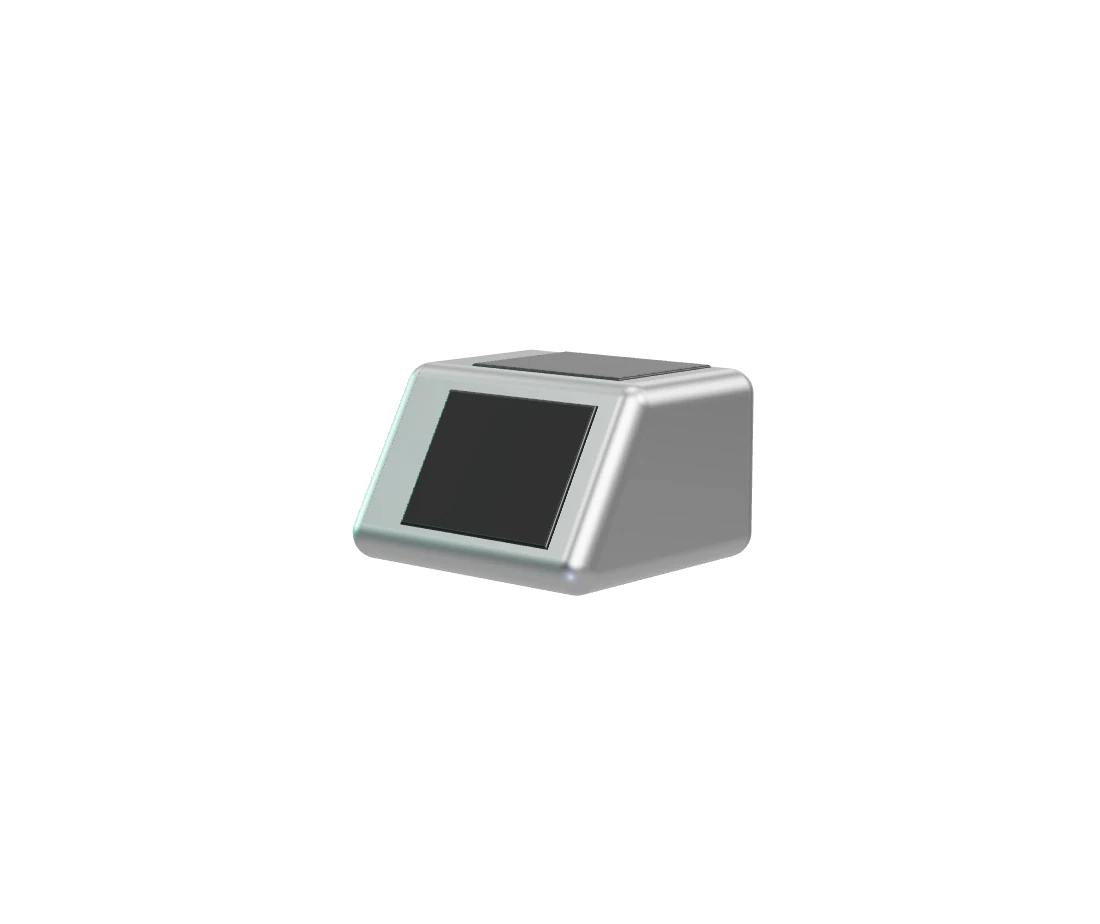
A miniaturised, patented multisensor node developed by TEKNE Engineering. An SMD 4-layer architecture stacks sensors, power, memory and radio inside an enclosure four centimetres a side.
No visible cables, no brackets, no impact on the display: it sits beside the work, or clamps to a column, and gets on with it.
Six read the air. Two read the matter.
The combination is the point: in the same sample, the state of the environment around the work and the mechanical response of the structure holding it. It is this density, in so small a volume, that made the patent possible.
Install it once. Then forget it.
A rechargeable battery and two micro solar panels built into the enclosure: energy harvesting takes what the room's light gives and pushes autonomy past twelve months of continuous operation.
No wiring to run to the work, no recurring maintenance. On an installation of dozens of nodes, that is the difference between a pilot and a system that stays on.
From sensor to cloud, without losing a reading.
Every sample is written locally to the node’s FRAM. The Air Station datalogger collects it on a timing set during analysis and sends it to the proprietary cloud core, where the data is processed and served to the control panel.
Two channels, two safeguards: local acquisition via app for on-site inspection, remote acquisition for continuous monitoring. Once the agreed thresholds are crossed, the system raises visual alerts or actuation events.
The data, as it happens.
Eight channels listening, live traces, thresholds and an event log. The predictive model works on the history and projects six hours ahead.
In the room, or on the other side of the country.
Continuous monitoring, processing and automated reporting from the cloud panel. On site, the dedicated mobile app reads a single node's memory, with no network needed.
Born for a work of art. Adopted by a building.
A built-in accelerometer and inclinometer make the same node usable for civil structure monitoring: bridges, viaducts, historic buildings, industrial plants. No redesign, no second product: the context changes, the device does not.
The MICROCLIMATE Guard multisensor in its main Applications
Structure, environment and building services measured continuously on a BIM model and gathered into a single control panel. MICROCLIMATE Guard is the family that reads the environment, alongside the structural sensors, on the same points of the model.
Thresholds agreed room by room, the event log and reporting in the cloud panel, with the app reading a single node’s memory on site. MICROCLIMATE Guard is what measures: six channels on the air, two on the matter.
From a system that measures to a system that predicts.
Want to see it working on your own collection?
One node, one room, your parameters. From threshold analysis to the first samples on the console, in a single session on site.
96010 Melilli, Italy
40054 Budrio, Italy